
DHAKA — Faster information does not always bring better understanding. That was the message from more than 100 researchers, scholars and media professionals who met in Dhaka this week to discuss how digital technology is reshaping communication across the Trans-Himalaya region.
Participants came from China, Bangladesh, Nepal, Bhutan, India, Sri Lanka, Pakistan, the United States, Canada and other countries. The theme was “International Communication and Regional Development Governance in the Trans-Himalaya Region in the Era of Digital Intelligence.”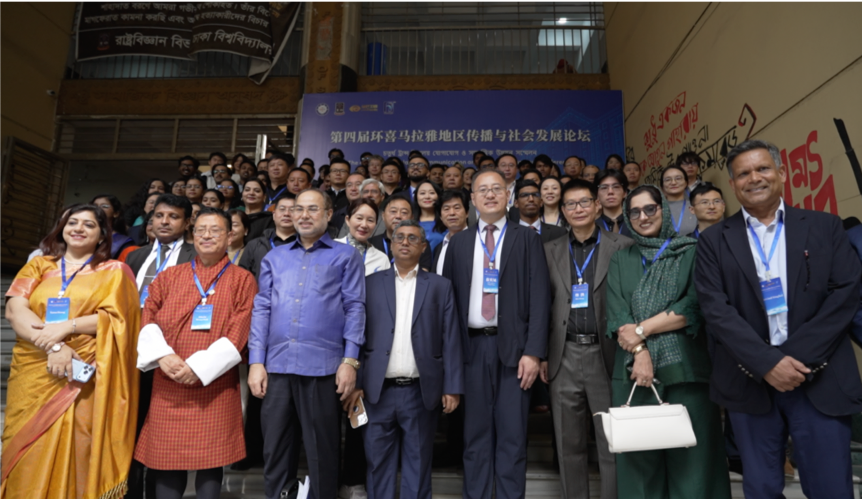
Organisers described the region as a shared information “neighbourhood” facing common pressures. Misinformation travels across borders faster than before, climate risks ignore boundaries, and artificial intelligence and algorithms are changing the media landscape while public trust erodes.
At the opening ceremony, speakers from different countries kept returning to two words: communication and trust. Many noted that the scarcest resource today is not technology but verifiable information, empathetic storytelling and space for ordinary voices to be heard.
Climate, development and journalism
A Bhutanese delegate said Bhutan’s Gross National Happiness philosophy offers a lens for communicating development.
“Communicating development in that spirit requires difficult questions. Who benefits? Who remains excluded? How do people themselves define progress?” the delegate said, adding that development journalism must look beyond launches and success stories. “It should follow what happens after the ceremony, when officials have left and communities begin living with a project’s consequences.”
On climate, the delegate said Bhutan’s conservation record does not shield it from floods, landslides or glacial lake outburst risks. “A disaster upstream can affect communities downstream,” the delegate said, calling for journalists to work with scientists and counterparts in neighbouring countries, for educators to share verification and data-reporting resources, and for media associations to build networks for ethical practice.
“Such cooperation need not mean identical media systems,” the delegate said. “We can respect national contexts while learning from each other.”
The delegate also urged newsrooms to set clear rules for using AI. “Journalists must verify generated material, protect confidential information, explain relevant uses of these tools, and remain accountable for what they publish. Responsibility cannot be transferred to software.”
Fake footage after Nepal floods
A professor from Nepal cited the catastrophic flash floods in Nepal’s mountains in August. Fake footage and AI-generated content, he said, were used to turn a natural disaster into a geopolitical incident.
“Rapid creation and systemic amplification of fabricated narratives can trigger widespread public chaos, paralysing crisis response mechanisms and destabilising communities,” the professor said.
He called on Trans-Himalayan countries to build a more resilient and interconnected information ecosystem. Its cornerstone, he said, should be the rapid circulation of cross-verified scientific data through cross-border institutional networks for empirical evidence, collaborative fact-checking and data transparency.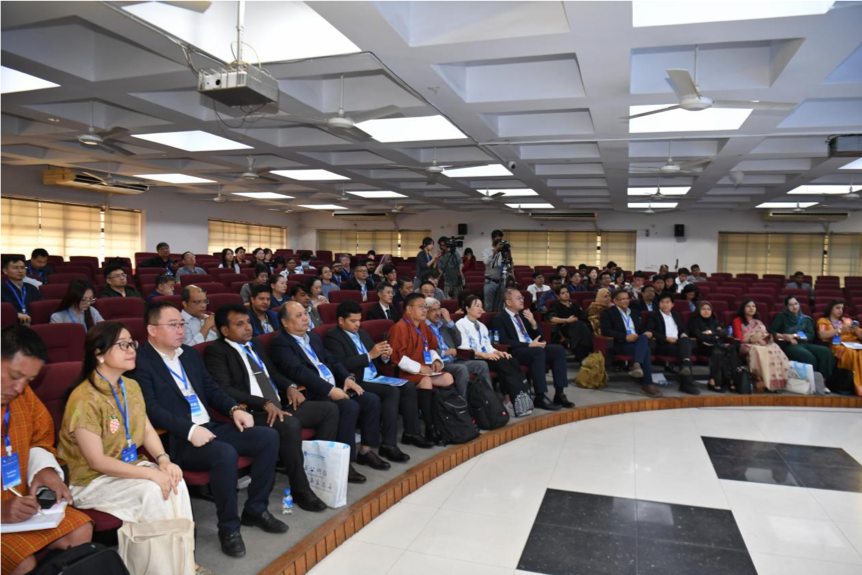
Academia and media
The conference continued its model of pairing academia with media. Universities provided research, while broadcasters offered communication networks and real-world cases. Keynotes ranged from Gandhian humanistic thought and digital social transformation to cross-border climate risk and disinformation governance in the AI era. Six sub-forums covered regional development, platform algorithms, youth expression, cross-border communication, media cooperation and ethnic exchange.
A “Media Forum” brought together media representatives from China, Bangladesh, Nepal and Bhutan to discuss credibility, trust and media responsibility. Many participants pointed to the long-running co-production between Kangba TV and Himalaya Television as an example of regional collaboration that does not force a single narrative.
“We are not looking for a standard answer, but for a way to ask questions together,” a participating scholar said.
After earlier editions in China and Nepal, participants agreed that South Asian countries could take turns hosting the forum, turning it from an occasional gathering into a regular regional platform. The programme also included a media industry study tour in Bangladesh, a “Himalayan Charms” photo and video exhibition and a “Humanistic China” book exhibition.
The 4th Trans-Himalaya Communication and Social Development Conference opened on November 8 at the University of Dhaka and concluded on November 11. It was jointly hosted by the University of Electronic Science and Technology of China, the University of Dhaka, Kangba TV and Himalaya Television.









Leave a Reply