
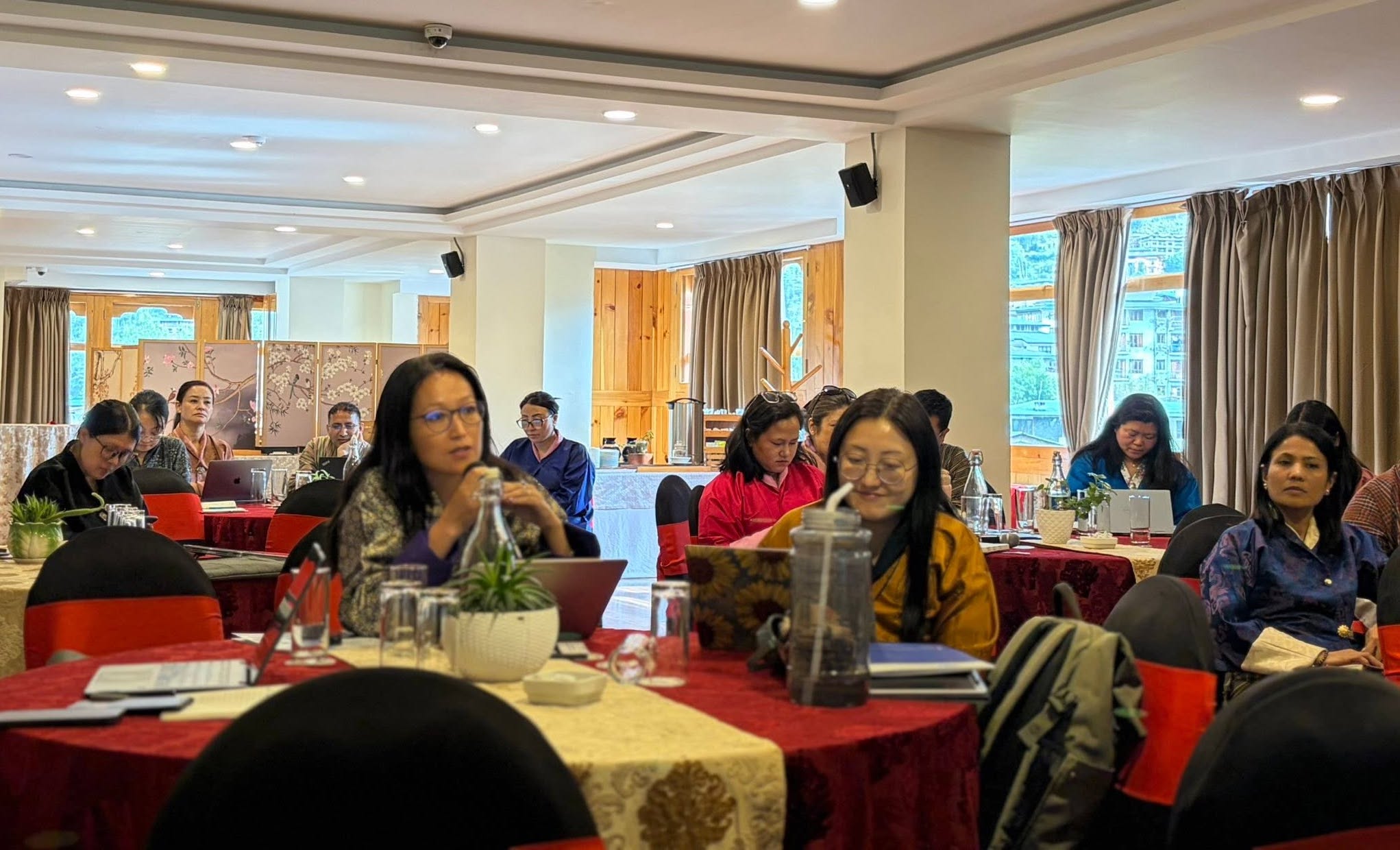
THIMPHU – Over the three days in Haa, surrounded by the calm rhythm of mountains and shifting skies, journalists from various media houses, both print and broadcast, immersed themselves in the art and science of climate change and environmental reporting. The participants’ reflections revealed not only what they learned but also how the training reshaped their understanding of journalism, community, and environmental responsibility. Their insights highlight key learnings, personal growth, and ways they plan to apply these lessons in their professional work. From the 25 participants, eight shared thoughtful reflections on their learning experiences from September 29 to October 1, 2025, presented below:
Kinzang Loday, Producer, BBS
For Kinzang Loday, the training was both eye-opening and transformative.
“The sessions deepened my understanding of climate change and environmental reporting,” he said. “I gained valuable insights into how scientific research supports credible journalism and learned effective ways to integrate data into stories.”
He found the scientific foundation of the training particularly useful — understanding how accurate data and verified research enhance the reliability of climate reporting. “I also learned how landscaping and greening can serve as carbon sinks that help reduce climate stress,” he noted.
The training’s focus on long-form, narrative-driven storytelling resonated deeply with him. “It taught me how to craft stories that not only inform but emotionally connect with readers — stories that move people to reflect and act.”
Kinzang Loday plans to bring this learning into his newsroom. He intends to produce scientifically grounded stories that translate complex climate data into relatable narratives. “By using compelling storytelling techniques,” he said, “I hope to make climate change issues more human-centered and accessible, sparking dialogue and awareness among diverse audiences.”
As a practical idea, Kinzang Loday wants to explore a long-form feature connecting micro-weather changes to daily lives in Bhutanese communities. “I want to show how unpredictable weather patterns are altering livelihoods, traditions, and routines,” he shared, “and how climate change is shaping the rhythm of ordinary people’s lives.”
Sonam Choden, Reporter, Bhutan Today
For Sonam Choden, the Haa training helped bridge the gap between data and dialogue.
“The sessions deepened my understanding of climate and environmental issues within Bhutan’s context,” she said. “I learned to interpret scientific data and transform it into accurate, engaging stories that foster informed public discussion.”
She added that the programme emphasised journalistic responsibility — to communicate without sensationalism. “We learned that effective reporting is about balance — presenting urgency without exaggeration.”
Sonam Choden also said the training gave her confidence to approach complex environmental topics. “It simplified technical terms and helped me see how to explain these issues clearly. Practical exercises and expert feedback provided a structure for writing stories that link global challenges to local experiences.”
Looking ahead, she believes collaboration among journalists is key. “By producing consistent, fact-based stories that highlight both challenges and solutions, and by including diverse voices from farmers to policymakers. we can make our reporting more impactful and inclusive,” Sonam Choden said.
Yeshey Lhadon, Freelance Journalist
For Yeshey Lhadon, returning to Haa — where she studied as a student in 2011 — was an emotional homecoming.
“It was impossible not to notice how much the climate had changed,” she reflected. “Haa felt warmer, the air softer, the wind gentler. This training was not just professional — it was deeply personal.”
In her detailed reflection, Yeshey Lhadon, who was the former editor of Bhutan Today, described each day’s journey as a blend of science, ethics, storytelling, and self-discovery.
Day 1: Science and ethics of climate reporting
The session with Ugyen Chophel, Deputy Chief of the Department of Hydrology and Meteorology, grounded participants in Bhutan’s changing climate — rising temperatures, erratic rainfall, and the growing risk of floods and landslides. “The data was sobering but essential,” she wrote, “reminding us that credible reporting begins with understanding science.”
Ox Media’s Tshering Dorji then led a powerful session on ethics. “He reminded us that while passion drives our stories, integrity sustains them,” Yeshey Lhadon said. “Our duty is to report, not to rally.” His example of the Vanity Fair cover — combining Leonardo DiCaprio and a polar bear from different locations — sparked a vivid discussion on truth and representation in journalism.
Dr. Bhupesh Adhikary, Climate Action Lead at International Centre for Integrated Mountain and Development (ICIMOD) based in Kathmandu, Nepal, joined virtually to discuss the Climate and Environmental Crisis in the Hindu Kush Himalaya (HKH). He presented data showing that 2024’s global temperature was 1.55°C above pre-industrial levels, with Asia warming almost twice as fast.
Catherine Parrie, a landscape architect from Australia and currently working as a volunteer with the Green Bhutan Corporation Limited (GBCL), added a new dimension with her talk on urban forest planning and stormwater management — showing journalists how design and sustainability intersect with climate resilience.
Day 2: People, Biodiversity, and Change
The day’s highlight was the session by Tshering Tobgay, Research Officer at the Royal Society for Protection of Nature (RSPN), on community conservation and indigenous perspectives. “We were reminded that Bhutan’s environmental ethos is rooted in spirituality and local stewardship,” she said. “Our ancestors practiced conservation long before it became policy.”
Yeshey Lhadon recounted the group’s impromptu discussion on glacial retreat and hydropower impacts when a scheduled speaker couldn’t attend. “We realised that science and lived experience often tell the same story — that the climate is no longer what it used to be.”
A field visit to a fishery pond below Meri Puensum left a deep impression. “The caretaker explained how warmer waters delay spawning and affect yields. It was a quiet but powerful lesson — that even small shifts in temperature ripple through ecosystems.” Haa’s fishery, which is managed by the National Research Centre for Reverine and Lake Fisheries, is focused on cold water species, particularly rainbow trout.
Day 3: Long-Form Storytelling
Under the guidance of Needrup Zangpo, Consultant, Mad Yogi Consultancy, and Rinchen Dorji, editor-at-large with Bhutan Times, participants explored narrative journalism in depth. “We learned to slow down, to listen, to observe. Long-form writing is not just a format — it’s a mindset,” Yeshey Lhadon said.
For her, the biggest takeaway was learning to blend accuracy with empathy. “Journalism’s strength lies in truth-telling — when done ethically, it becomes its own form of quiet advocacy.”
As the Haa valley wore a soft cloak of gloom, a light drizzle falling gently over the fields as mist drifted between the mountains, she reflected, “I left with renewed purpose — to tell stories that honor both science and soul, to listen to the land, and to give voice to the silent transformations shaping Bhutan’s future.”
Gaki Om, Assistant Producer, BBS Radio
For Gaki Om, the training turned complex science into approachable stories. “Even though some concepts were technical, the facilitators explained them clearly,” she said. “I learned that climate reporting isn’t just about alarming statistics, it’s about making people care.”
Understanding long-form journalism, she said, opened new perspectives. “It’s about empathy — stepping into someone’s world and telling stories that connect science with emotion.”
Gaki Om emphasised localisation as key for Bhutanese audiences. “Instead of quoting global data alone, I’ll highlight how farmers, herders, and families experience climate change firsthand,” she said. “When people see themselves in the story, they start to care.”
She also reflected on the importance of blending data, visuals, and human-interest elements. “Data gives credibility, visuals add clarity, and human stories bring emotion. Together, they make climate issues real.”
Ngawang Jamphel, Reporter, Bhutan Times
“The training enhanced my ability to connect global climate discussions with Bhutan’s realities,” Ngawang Jamphel said. He appreciated learning how to interpret data, analyze policy, and focus on solutions rather than problems.
“Yes, I now feel more confident,” he added. “The sessions helped me simplify complex information and communicate it effectively to the public.”
For him, collaboration and consistency are crucial for impactful journalism. “By working with experts and communities, journalists can produce engaging, fact-based stories that support Bhutan’s environmental goals and resilience.”
Kipchu, Editor, BBS TV
Kipchu valued the training’s deep dive into scientific frameworks like the IPCC Assessment Reports and Shared Socio-economic Pathways. “Understanding these global structures helps us place Bhutan’s story within the international climate dialogue,” he noted.
He plans to make future coverage more human and visual. “I’ll focus on local examples, using clear language and before-and-after contrasts to illustrate climate impacts vividly,” he said. “Data shows scale, visuals make it visible, and human-interest elements make it relatable.”
Yangyel Lhaden, Reporter, Kuensel
For Yangyel Lhaden, the training provided practical ways to make climate stories relevant to Bhutanese readers. “I plan to localise stories — focusing on agriculture, water, and livelihoods,” she said. “By highlighting how climate change touches daily life, we can make audiences understand and care.”
She stressed the importance of combining data with emotion. “Charts, maps, and visuals help explain the science, but people connect most with real stories — farmers, students, community leaders who live the reality of climate change.”
Yangyel Lhaden acknowledged challenges in accessing reliable data and scientific resources but expressed determination to overcome them. “Building networks with experts and simplifying complex ideas through storytelling will help journalists make climate reporting more impactful.”
Samten Dolkar, Anchor/Reporter, BBS TV
For Samten, the training was a rediscovery of her own storytelling roots. She recalled childhood memories of her father, a forest ranger, walking into the mist. “He said, ‘The forest is alive. It breathes.’ I didn’t understand it then — but now I do,” she said.
Through the Haa sessions, she realised that climate change is not an abstract issue. “It’s here — altering rivers, crops, and the rhythm of rural life,” she said. “The training helped me connect science with emotion.”
Learning about the “looping technique” in long-form writing, she said, changed her approach. “A story that begins with an image and returns to it with new meaning mirrors the cycle of nature itself. It’s how we make readers feel the story, not just read it.”
“As I left Haa,” she reflected, “I thought of my father. He still listens to the forest — and now, I too am learning to listen. The training reminded me that good stories breathe, just like the forest does.”
A shared commitment
Together, participants expressed gratitude for the Journalists Association of Bhutan and the Government of Australia for enabling this platform for learning. Across reflections, a shared theme emerged — a renewed sense of responsibility to tell climate stories that are accurate, ethical, and emotionally resonant.
As one participant summed it up, “This training wasn’t just about reporting better — it was about seeing differently: listening to the land, honoring the people, and telling stories that truly matter.”








Leave a Reply