
THIMPHU – When Yeshey Lhadon returned to Haa after more than a decade, the valley felt both familiar and foreign. “I studied here in 2011,” she recalled, gazing at the slopes of Meri Puensum. “Back then, mornings were cold and crisp — the frost sparkled on rooftops. But this time, the air felt softer, warmer. I could sense the change.”
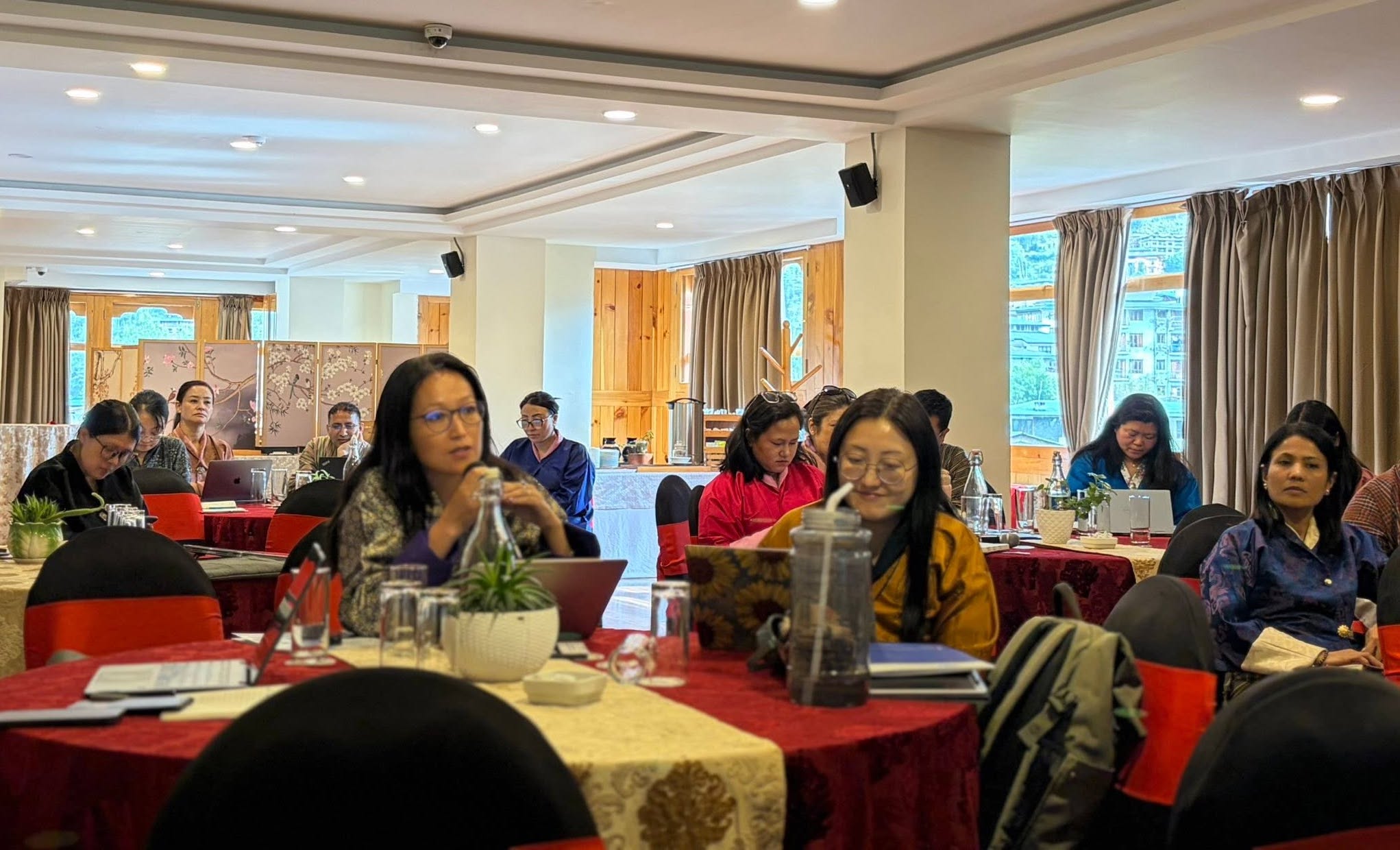
Her reflection captured the essence of the three-day training on Strengthening Climate Change and Environmental Reporting through Long-form Narrative Journalism, held in Haa from September 29 to October 1, 2025. The training brought together 25 journalists, including editors, from various media houses.

Organised by the Journalists’ Association of Bhutan (JAB) with support from the Government of Australia through contract management by ABC International Development (ABCID), the training brought together journalists from print, radio, and digital platforms to deepen their understanding of climate science, reporting ethics, and storytelling.
For Yeshey Lhadon, a freelance journalist, the experience was personal as much as professional. “I wasn’t just learning about climate change,” she said. “I was witnessing it unfold in a place that shaped my own story.”
Learning the science and the ethics
The first day began with a session on The Science of Climate Change led by Ugyen Chophel from the Department of Hydrology and Meteorology, who explained Bhutan’s warming trends, erratic rainfall, and increasing climate risks.
An icebreaker followed, where each participant described themselves as a weather element — fog, drizzle, sunshine, wind, thunderstorm, lightning or Tsunami. Yeshey Lhadon called herself a hurricane. “Unpredictable, emotional, but full of purpose,” she said with a smile.
Later, Tshering Dorji, a media consultant, challenged participants to reflect on responsible reporting. “Our duty is to report, not to rally,” he reminded. Using an example of Vanity Fair’s digitally composited image of Leonardo DiCaprio and a polar bear, he underscored how even well-intentioned storytelling can cross ethical lines.
He also drew attention to “species bias” in journalism — the tendency to spotlight majestic animals like tigers while overlooking smaller but equally vital species. “Every species matters,” he said. “Not just the ones that make headlines.”
That afternoon, Dr. Bhupesh Adhikary, Climate Action Lead at International Centre for Integrated Mountain and Development (ICIMOD) based in Kathmandu, Nepal, joined virtually to discuss the Climate and Environmental Crisis in the Hindu Kush Himalaya (HKH). He presented data showing that 2024’s global temperature was 1.55°C above pre-industrial levels, with Asia warming almost twice as fast.
He introduced the concept of climatic impact-drivers — physical climate conditions that directly affect society or ecosystems — and urged immediate action. “1.5°C is already too hot. We must save our snow,” he warned.
Connecting communities, culture, and conservation
Day 2 turned toward people and biodiversity. Tshering Tobgay from the Royal Society for Protection of Nature (RSPN) spoke on Community Conservation and Indigenous Perspectives, highlighting Bhutan’s spiritual and cultural roots in environmental stewardship.
Discussions covered Bhutan’s ecological successes, such as conserving the Black-necked Crane and White-bellied Heron, and the growing threats of habitat loss, floods, and changing river systems.
A field visit to a fishery pond beneath Meri Puensum illustrated how subtle temperature changes affect aquatic life. “Even the fish are telling us that the climate is different now,” Participants observed as the caretaker explained how warmer water delays trout spawning.
Throughout the day, the valley’s shifting weather seemed to echo their discussions — mist rolling in, sunshine breaking through, drizzle returning. “It felt like the sky was participating in our training,” one participant said.
The art of storytelling
The final day, led by Needrup Zangpo, focused on the craft of long-form journalism — slowing down to let stories breathe. Joined by Rinchen Dorji, Editor-at-Large at Bhutan Times, they explored character-driven storytelling, narrative structure, and emotional truth.
“Long-form writing is not just about length,” said Yeshey Lhadon, who was the former editor of Bhutan Today. “It’s about depth — listening deeply, observing closely, and connecting emotionally.”
Catherine Parrie, a landscape architect from Australia and currently working as volunteer with the Green Bhutan Corporation Limited (GBCL), added a new dimension with her talk on urban forest planning and stormwater management — showing journalists how design and sustainability intersect with climate resilience.
By the end of the day, participants pitched story ideas — from hydropower and glacial retreat to community adaptation and biodiversity conservation — blending science with humanity.
A shared commitment
The training ended with a renewed sense of purpose — not only to inform but to inspire.
Kinzang Lodey from BBS said the program deepened his understanding of how science strengthens storytelling. “I learned how to translate complex data into stories that people can relate to,” he said. “I want to produce reports that are factual, emotional, and actionable — stories that make people care.”
Ngawang Jampel of Bhutan Times reflected on connecting the global to the local. “Climate change isn’t just happening somewhere else — it’s shaping our daily lives,” he said. “I feel more confident now in simplifying scientific data and linking it to real Bhutanese experiences.”
For Sonam Choden from Bhutan Today, the key takeaway was ethical clarity. “The training reminded us that responsible reporting is not about dramatizing facts but making them understandable,” she said. “We have to promote awareness, not alarm — and ensure the public trusts our work.”
Gaki Om, a radio assistant producer from BBS, emphasised the human touch. “Data gives credibility, but people give meaning,” she said. “When we combine facts, visuals, and voices from real communities, our stories become powerful and relatable.”
Together, the journalists agreed that collaboration, consistency, and compassion are essential to sustain meaningful climate journalism in Bhutan.
A hopeful horizon
When the training wrapped up and participants prepared to return home, the Haa valley wore a soft cloak of gloom, a light drizzle falling gently over the fields as mist drifted between the mountains — as if nature itself was pausing in reflection. Yet beneath the grey skies, there was a quiet radiance, a sense of renewal that mirrored the spirit of the journalists leaving the valley.
“This training wasn’t just about reporting better,” said Yeshey Lhadon, packing her notes. “It was about seeing differently — listening to the land, honoring the people, and telling stories that truly matter.” For the journalists who attended, the drizzle felt like a benediction — a reminder that from clouds, too, comes clarity. They departed Haa with a shared commitment: to tell stories that not only inform but also inspire action, bridging science with human experience, and truth with hope.








Leave a Reply